

You’ve probably seen the line: NGOs have until 13 May 2026 to restructure governance and financial reporting under the PBO Act, and only 4,000 of 14,000 registered NGOs are compliant.
Both halves are out of date. The 4,000 figure comes from the Authority in May 2025. It counted organisations that had transitioned to PBO status, not compliant organisations. And 13 May 2026 has come and gone.
The headline did get one thing right, though. It said financial reporting, not just registration. That’s the part almost no one is writing about.
Where the deadline actually stands
The transition deadline was 13 May 2026. A special gazette notice dated 12 May extended it by one year, to 14 May 2027. Around the same time, the PBO Regulatory Authority confirmed what the High Court had already held: organisations registered under the repealed NGO Act transition automatically. You don’t need to apply afresh.
That removed the panic. It didn’t remove the work.
You still have to submit your old certificate, an aligned constitution, board minutes, and the prescribed form, so the Authority can update its register and issue your PBO certificate. That’s your advocate’s job, and you only do it once.
What isn’t a one-off is the reporting rhythm the Regulations create. It runs every year, on a clock, under an Authority that can now suspend your ability to transact. A finance function built on spreadsheets will struggle to keep up.
Four obligations that are really systems obligations
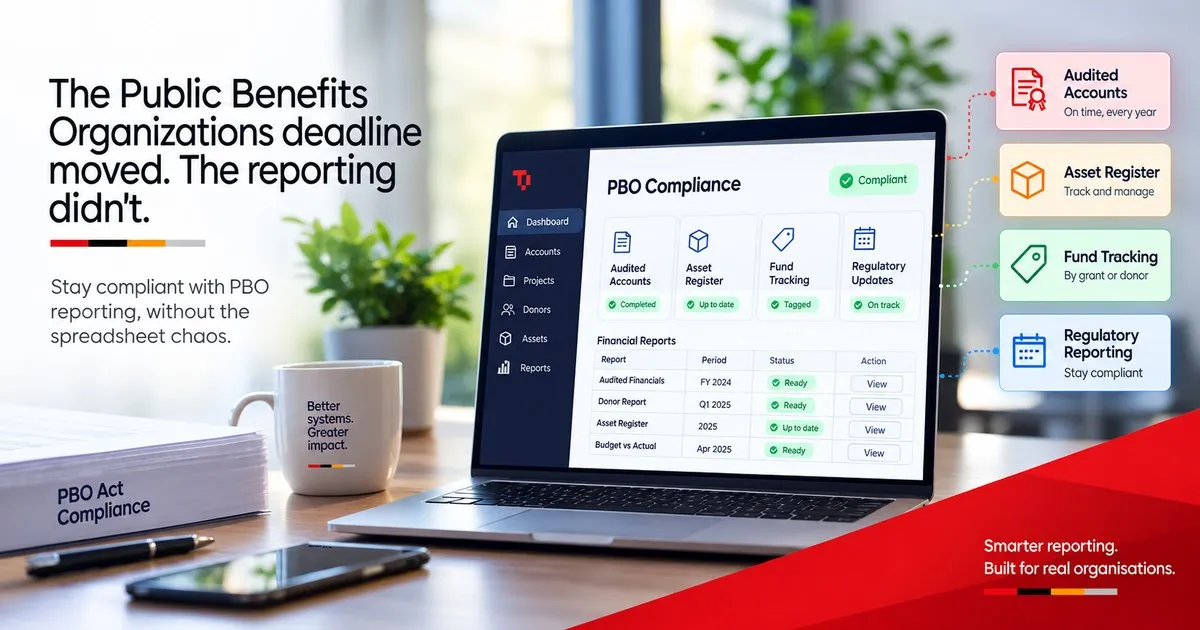
1. Audited accounts within six months. Every PBO must file audited accounts and an activity report within six months of year-end. With a 31 December year-end, that means every June. Six months sounds generous until you work backwards. The audit needs closed books. Closed books need donor reconciliations. And those reconciliations are still in a workbook on someone’s laptop.
2. A maintained asset register. This means a register kept up all year, not a schedule built for the auditor in June. In Excel, it always fails the same way: the vehicle written off last year is still on it, the laptops in Turkana aren’t, and no one can say which grant paid for what.
3. Spending traceable to its funder. The Regulations require you to disclose funding sources, and donors already want spending reported by grant. If your ledger only knows totals, you rebuild every funder report by hand. The allocation the auditor tests then exists only in that hand-built workbook.
4. Material changes on a clock. Board changes, constitution changes, and new bank accounts each have a notification window. The clock starts when the change happens, not when finance hears about it. Opening a new bank account is a finance event. If your system doesn’t flag it, you may already be late.
Behind all of this is a new kind of enforcement. The Authority can suspend an organisation, which freezes its financial transactions, and it can deregister organisations that don’t comply.
What this looks like in Business Central
You don’t need new software for its own sake. What you need is for four things to come out of the system instead of out of a person.
Fixed-date close. Year-end close, audit trail and financial reporting run on the ledger, not in Excel.
A live asset register. Acquisition, depreciation, disposal, location and custodian are updated as assets move. That’s the Fixed Assets module in Business Central.
Every transaction tagged. Donor, grant and project are recorded as dimensions on every posting. A funder report takes a filter, not a fortnight.
Staff costs where they belong. Your largest cost is allocated to the right grant at source, from the payroll system you already use. In Business Central this is set with default dimensions on the employee record.
None of this is exotic. The first three come with the standard Business Central licence. Many organisations already running Business Central own all of it and have set up none of it.
If you’re not on Business Central yet
Most NGOs we speak to run QuickBooks, Sage Pastel or a set of spreadsheets. For them, the real question isn’t configuration. It’s whether to move, and when.
Moving usually makes sense if you report to several donors on different grant periods, if staff time is split across grants by hand, or if your audit prep starts with someone rebuilding the year in Excel. It usually doesn’t if you have one or two funders and a simple structure. A well-kept smaller system is fine, and we’ll tell you so.
When a migration is the right call, it follows a set order:
Redesign the chart of accounts around dimensions. The most common mistake we see is a separate GL account for each donor. It works with three funders and falls apart with ten. Donor, grant and project belong in dimensions. The chart of accounts stays short and stable.
Bring in opening balances, not ten years of history. Migrate balances and open grant positions at a clean cut-off, ideally the start of a financial year. Keep the old system read-only for the auditor.
Connect what already exists. Payroll, bank feeds and M-Pesa should flow into the ledger, not be re-keyed. Connecting accounting systems to Kenyan payroll, banks and payment platforms is our specialism, so your existing tools keep working.
Run one month-end in parallel before switching off the old system. That month builds more confidence than any demo.
Timing follows from this. If your year ends on 31 December, starting on 1 January means next June’s audit runs entirely on the new system. For that to happen, the design work has to begin this quarter.
The honest part
We’re TrendPro Systems, an authorised Microsoft Cloud Solution Provider in Nairobi. We supply Dynamics 365 Business Central licences and implement them, so licensing, setup, and support sit in one contract. Our team has public sector experience, where every shilling has to be traceable.
We don’t do compliance. Your advocate handles registration and the transition pack. A system’s job is to produce the records those rules call for, on the date they’re due. Anyone who tells you their software makes you compliant is selling something they can’t deliver.
If your donor reports already come from your accounting system and your asset register is live, you’re ahead of most of the sector. There’s nothing here for you to buy.
If you’d like to talk it through, it takes 20 minutes, and there are no slides. Write to info@trendpro.co.ke or call +254 723 343 353. If your setup is fine, we’ll let you know.
Wilfred Onsongo | TrendPro Systems Limited | Microsoft Dynamics 365 Business Central partner and authorised Cloud Solution Provider, Nairobi
This article summarises publicly reported requirements and is not legal advice. Confirm the details with your advocate and against the Public Benefit Organizations Regulations, 2026.